

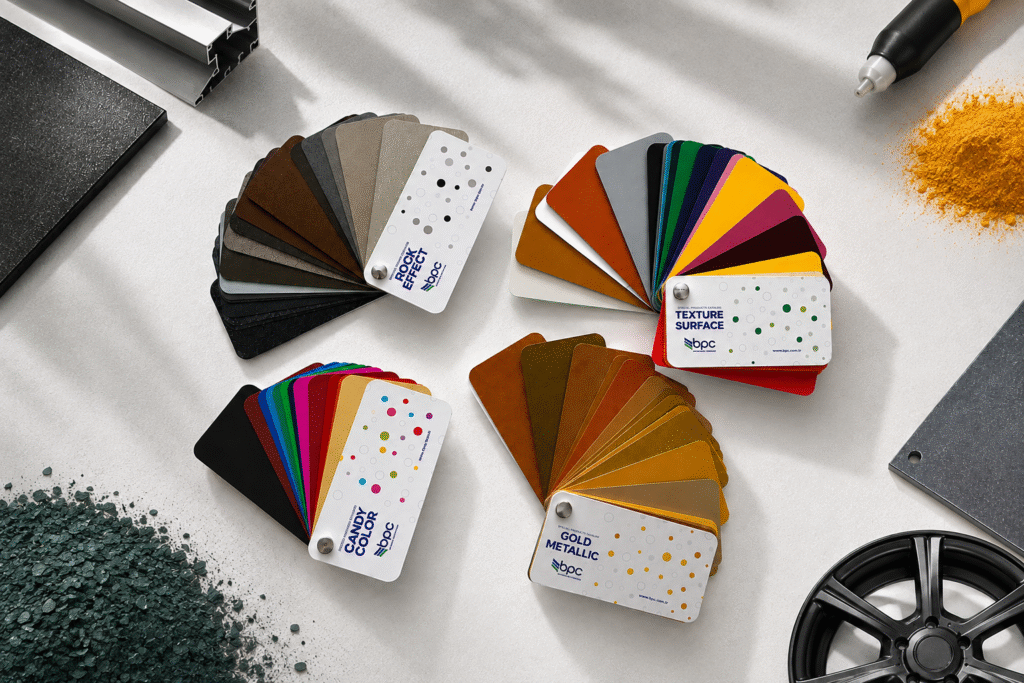
When a powder-coated metal part first comes out of the oven, the surface may look flawless. The color appears uniform, the gloss is at the desired level, and the coating has flowed evenly across the surface.
But can we really say that the coating is high quality while the metal is still hot?
Partly, yes. However, evaluating quality based solely on the appearance of a hot surface is not enough.
What Can the Surface Tell Us Right After the Oven?
After curing, the first visual indicators of the coating become visible. An experienced eye can assess several aspects even while the part is still hot:
- Color and gloss uniformity
- Orange peel and surface smoothness
- Craters, pinholes, or blistering
- Flow and film formation
- Coating behavior on edges and corners
- Effect distribution in metallic or special-effect coatings
These indicators provide valuable clues about how the application and curing process has performed.
However, there is one important distinction:
A surface that looks good does not always mean the coating will perform properly.
The Critical Point: Curing
In thermosetting powder coatings, oven curing does more than simply melt the powder and allow it to flow across the surface. It also initiates the chemical crosslinking process that enables the coating to achieve its final properties.
Therefore, even if a freshly coated part looks perfect when it comes out of the oven, the coating may still be under-cured.
Insufficient curing can lead to problems over time with adhesion, hardness, chemical resistance, and mechanical performance.
Similarly, excessive temperature or prolonged curing may cause undesirable effects in certain coating systems, such as changes in color or gloss.
For this reason, focusing only on the question “What is the oven temperature?” is not enough.
What really matters is whether the coated metal reaches the required temperature and remains at that temperature for the period specified for the product.
Why Is Metal Temperature Important?
The air temperature inside the oven and the actual temperature of the metal part are not the same.
Factors such as:
- Part thickness
- Geometry
- Weight
- Type of metal
- Line speed
- Oven design
can all affect the actual metal temperature.
A thin sheet and a thick metal profile passing through the same oven may not heat up at the same rate. Therefore, proper curing should be evaluated based not only on the oven setting but also on the actual time–temperature profile of the coated part.
When Can We Truly Assess Quality?
Once the part has cooled, different tests can be carried out depending on the application and expected product performance.
Film thickness, adhesion, hardness, impact and bending resistance, color and gloss measurements, chemical resistance, and corrosion performance can provide a much more comprehensive picture of the coating’s actual performance.
Because in powder coating, quality is not only about how the surface looks, but also how it performs over time.
The Right Powder Coating + The Right Process
Even a high-performance powder coating may fail to deliver the expected results if it is not applied correctly. Likewise, a well-managed application process cannot fully compensate for a coating system that is unsuitable for the intended service conditions.
A successful coating requires the right combination of:
the right product + proper surface preparation + correct application + proper curing conditions + effective quality control
At BPC, our powder coating solutions are developed not only with the initial appearance in mind, but also with a focus on long-term coating performance across different surfaces, industries, and operating conditions.
Because the story of a high-quality coating does not end when it comes out of the oven.
True quality is the ability of the coating to maintain its performance long after the surface has cooled.
At BPC, we consider not only how a coating looks at the time of application, but also how it will perform throughout its service life. We develop our products according to the requirements of different surfaces, industries, and operating conditions, combining consistent color and surface quality with durability and long-lasting performance.


